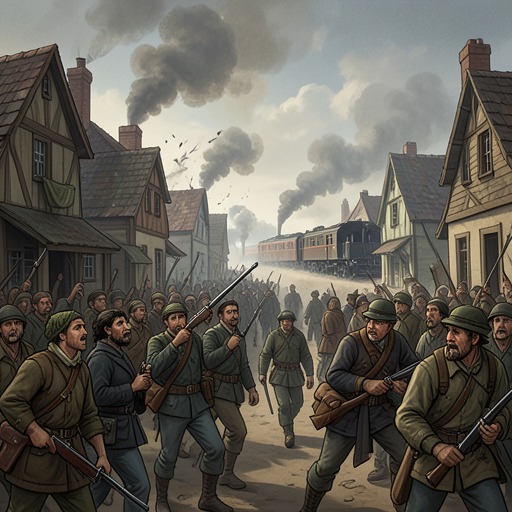
The First Battle Near the Ruthven Plantation
Young Captain Jack · The Son of a SoldierThe First Battle Near the Ruthven Plantation is the first decisive wartime test of the Ruthven home as both a private household and a field hospital. The action converts the plantation from a domestic refuge into a contested border between retreating armies, wounded men, civilians, and marauders. Jack Ruthven's defense of the property gives the battle its central meaning: courage is joined to restraint, and military danger is judged against obligations to the defenseless.
Causes and Wartime Setting
The crisis grows out of the Confederate retreat and the Union advance. Around Oldville, the district surrounding the Ruthven plantation, the war has moved close enough for cannon fire to be heard, and the Confederate army is encamped less than four miles from Jack's home. When Jack looks through a spyglass, he sees Confederate soldiers moving along the woods in retreat and then observes Union troops approaching in numbers at least twice as great. The plantation is therefore exposed not because its inhabitants seek battle, but because the front has collapsed toward them.
The household also occupies an important humanitarian position. Hospital corpsmen bring wounded Confederates on stretchers and in ambulances while shells pass over the plantation and burst in the woods beyond. The shooting draws nearer, and six badly wounded Confederate soldiers are finally placed on cots in the sitting room under the care of a surgeon, with Mrs. Ruthven and Marion Ruthven assisting. The home is thus protected not merely as private property but as a place treating casualties who cannot safely be carried farther.
The surrounding civilian economy is already strained by the war. In Oldville, stores are closed or depleted, and even the general store kept by Lemuel Blackwood has a scanty, shop-worn stock. Against this background, the plantation's horses, buildings, and supplies become tempting targets. The battle's danger comes not only from organized armies but also from men who exploit military confusion for personal gain.
The Home Guard and the Defense
Jack responds to the retreat by calling out the Home Guard. Within half an hour, nineteen boys assemble, each carrying a loaded gun or pistol; Jack changes into his uniform, takes up his sword, and places the company in formation. Old Ben joins the defense with a long, old-fashioned horse pistol, promising to protect Jack if anyone tries to shoot him. Jack's gratitude strengthens the scene's sense of communal loyalty: the defense is a local undertaking made up of boys, household dependents, and people bound to the Ruthven home by affection rather than formal military power.
The emergency also demands practical sacrifice. Marion gives up her pet saddle horse so that a cannon can be moved more quickly along the retreating route. Jack recognizes the cost of the gesture because he knows how deeply she values the animal. Her action parallels his own: both defend others by surrendering something personally precious, while neither treats private possession as more important than immediate human need.
The first regular troops to pass are cavalry, who ride by without disturbing the homestead. They are followed, however, by a company of guerrillas led by Sandy Barnes. The narrator identifies these men as followers of every army who fight chiefly to loot afterward, separating them from soldiers retreating or advancing under military orders. When Barnes commands his company toward the house, Jack draws the Home Guard across the lawn and declares that they are the guard of the house.
Jack grounds his resistance in two concrete principles. The property is private and must be respected; more urgently, the house is a hospital containing six wounded Confederates in a surgeon's charge. He is not claiming the plantation as a military fortress or inviting unnecessary violence. He is asserting a boundary around civilians, medical care, and the wounded at the moment when ordinary boundaries are most vulnerable.
Confrontation with the Guerrillas
Barnes questions whether the boys intend to fight, and the Home Guard answers that they will. The threat becomes immediate when one guerrilla attempts to enter through a side door. Jack steps in front of him and raises his sword, warning him not to proceed. The guerrilla responds by raising his own sword, while several of his men lift their guns. Marion watches from a window in fear for Jack's life, and the plantation's domestic interior becomes the tense vantage point from which a violent breach of the home may occur.
The confrontation exposes the difference between resistance and predation. Jack's force is small, improvised, and defensive; the guerrillas possess greater immediate violence but no legitimate claim to the house. Their demand is not connected to military necessity, the treatment of prisoners, or the movement of troops. Their conduct is an attempted ransacking of a private home that has been converted into a hospital, making Jack's refusal both a personal act of bravery and a defense of wartime order.
The stalemate ends when a regiment of regular Federal troops appears on the road. The guerrillas recognize Colonel Stanton's regiment and understand that the colonel will not tolerate their conduct. Barnes orders a retreat toward the distant hills, and the Federal troops fire a volley that brings several of the outlaws down. The guerrillas are described as virtually outlawed and lose no time escaping from sight. Their withdrawal demonstrates that the same military presence threatening the plantation from one direction can also protect it from irregular violence.
Colonel Stanton's Intervention
Colonel Stanton rides onto the lawn and asks what has happened. Jack explains that the Home Guard is defending the home and that the departing men appeared intent on ransacking it. He cannot provide a complete answer to every question about the plantation's political allegiance, but he insists on the immediate facts: the property is private, and six wounded men are inside under a surgeon's care.
Colonel Stanton answers that an officer who is a gentleman respects private property. He adds that the household has nothing to fear from his men so long as it does nothing treacherous. This assurance establishes a moral and legal contrast with Barnes's company. The Federal regiment is still an enemy force in the larger war, yet Stanton recognizes limits on what soldiers may do when confronted with a civilian home and a hospital. Jack accordingly sees him as a gentleman, sharply unlike the guerrilla who threatened him with a sword.
The scene's value shifts from imminent violence to guarded safety. At first the Ruthven household faces both armies and marauders without knowing whether any approaching force will protect or plunder it. By the end, the guerrillas have been driven away, no member of the Home Guard has been hurt, and the Federal commander has explicitly pledged to respect the property and its wounded occupants. The danger has not vanished from the region, but the house has survived its first direct test.
Consequences and Narrative Significance
The battle establishes Jack as a protector whose authority arises from action rather than age or rank. He sees the retreat, recognizes the danger, summons the Home Guard, deploys its nineteen members, and personally places himself between the guerrillas and the house. His courage is not reckless aggression: he repeatedly frames his conduct as defense of women, private property, and the wounded, and he promises to be careful when warned not to act rashly.
The episode also defines the Ruthven plantation as a recurring moral space. It is a family home, a repository of private property, and a hospital whose doors must remain open to injured Confederates even while the surrounding battle advances. The events later echo when guerrillas attempt to steal horses from the stable and Old Ben and two Home Guard boys resist them. The repeated attacks show that the plantation's defense is not a single heroic spectacle but an ongoing struggle to preserve humane obligations amid military disorder.
The battle further prepares the novel's larger identity plot. The plantation is tied to the wreck on Hemlock Bluff rocks, from which Jack's unknown past begins to emerge; the wreck later yields a heavy black tin box, while the unmarked clothing, lace handkerchief, and worn ring preserve the only physical clues to his origins. Colonel Stanton's fevered cry about a shipwreck and saving his wife Laura and son Jack eventually connects the battlefield commander to Jack's lost family. When the stolen tin box is recovered from the outlaws' camp and its papers are returned to Colonel Stanton, the earlier pattern of danger, protection, and concealed inheritance moves toward recognition.
As an event, the first battle therefore joins military action to the novel's central ethical and genealogical structures. It contrasts the guerrillas' appetite for plunder with Jack's defense of human dignity, and it makes Colonel Stanton's respect for private property an early sign that wartime allegiance does not exhaust moral identity. The clash leaves the Ruthven home standing, protects the wounded inside it, confirms Jack's public courage, and helps prepare the later recovery of the evidence that reunites Jack with Colonel Stanton and restores the Stanton fortune.